
Ol’ Put ‘Er Down
Mashamoquet Brook State Park, Pomfret
2011 & 2017
I visited Wolf Den on more than one occasion, so I’m combining two separate pages into one.
2011
Ask people ‘round here where the Wolf Den is and they’ll most likely point you to Mohegan Sun Casino’s concert arena. And while that’s a late 20th-century structure about a half hour away from Pomfret’s much older, much smaller Wolf Den, there actually IS a historical connection between the two…

As you surely know, Pomfret’s Wolf Den is situated in Mashamoquet Brook State Park and Mashamoquet is a Mohegan-Algonquin word for “stream of good fishing.” The region was once the domain of the Mohegan Chief Uncas – and of course the Mohegans are the now-wealthy folks who own/owned the massive Mohegan Sun casino which, of course, contains the Wolf Den arena. It all makes perfect sense.
So what’s the story here? Why is this cavity between some rocks in the middle of nowhere important? it’s because one Israel Putnam, on a night in 1742, crept in and shot a wolf that for years had preyed upon local sheep and poultry. This was said to be the last wolf in Connecticut and Putnam finally killed him in this here den. Israel Putnam was later to gain fame as a Major General in the Continental Army during the Revolutionary War. He also, according to town literature, is said to have instructed his men at Bunker Hill, “Don’t fire until you see the whites of their eyes.” (History, however, more often attributes this famous quote to some guy named William Prescott.)

The den itself is now listed on the National Register of Historic Places and has a handsome hand painted sign affixed to the rock face outside the hole. It is located along the blue trail high up on a steep cliff-ridden hillside. During my visit, the den was full of water and certainly not inviting – to human or to beast. More on the story of the den below.
I’d be remiss if I didn’t mention some more about Israel Putnam. He is one of those guys with all sorts of lore attached to him. He has a town named after him (guess the name), a cottage (museum) in Greenwich and perhaps most importantly, Putnam Memorial State Park out in Redding and Bethel. There, Putnam held down a Revolutionary War camp that is known as the Valley Forge of Connecticut – and also has a museum and a visitor’s center.

Back down in Greenwich, another legend associated with Putnam is that he saw the British coming to attack, hopped on a horse and rode it down some stairs (an event commemorated in a statue at the Redding park) to escape via a route the Red Coats couldn’t follow. So, in short, stick around and read enough of this website and you’ll run into Ol’ Put again and again.
2017
Speaking of “again…” When I was doing the state’s Sky’s The Limit hiking challenges, one took me back to the Wolf Den… this time with my two boys.
For this adventure, I employed my kindly and fatherly “Let’s see how close we can get to the goal in the car to save your tender young legs” approach.

I had a full slate of stuff to do in Putnam after this hike, so I really didn’t want to start at the main entrance and spend two hours here. (And, if you know anything about my son Damian, spending two hours hiking with him isn’t usually the best idea.)
Yes, that’s right… we were off to the town of Putnam after leaving this place in Pomfret which is famous because of the exploits of Israel Putnam for whom the town was later named for.

So I found the single-track woods road off of Wolf Den Road known as… Wolf Den Drive. It’s not the best off-roading I’ve done, but it wasn’t the worst either. However, it’s definitely one of those, “Holy crap, I’m in this 100% since I literally can’t turn around until I get all the way to where I want to get.”
I got there.
And despite everything I just wrote, I could have actually driven in to a picnic area even closer to the Wolf Den we were seeking. Oh well. At least YOU can cheat even more now that you’ve read this.
I parked and the three of us walked down the very nicely cleared road/trail to the aforementioned picnic area. It’s funny that this was so easily drivable, but the road to get here is decidedly not.

Damian went through his usual progression of self-injurious behavior and opposition to the walk, but we continued to plug along. He usually gets over it in five or ten minutes. (And did.)
We entered the woods through a laurel stand and began descending down into a valley.

Damian became obsessed with the fact that there were “steps” in the woods. Over and over he had to confirm with me, “Papa. Steps.”
“Yes, Damian.”
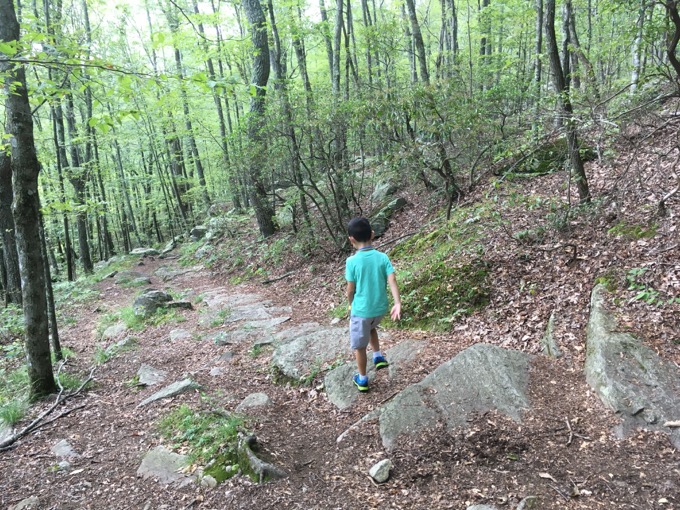
“Papa. Steps. In the woods.”
“Yes, Damian.”

“Papa. Papa! Steps! In the woods!”
“Yes, Damian.”
You get the point. (Actually, no you don’t. The child can perseverate like no one you know. It’s maddening if I’m being honest.)
And just like that, we’d reached our goal: The Wolf Den. I’ll just borrow some text from my friends at WNPR.
Israel Putnam is a name that stands out in the colonial history of Connecticut as a war hero of the French and Indian War and the American Revolution. Prior to his wartime glory, he earned the nickname “Wolf Putnam” by killing what was believed to be the last wolf in Connecticut when he was a young farmer in the eastern Connecticut town of Pomfret.
The disappearance of an animal from its native habitat is no longer cause for celebration, but life in the mid-1700s was very different than today. To make a go of farming, you were up against many obstacles—the harsh New England winters, rocky soil, and predators destroying your livestock. A wolf was not viewed as a mysterious, beautiful wild animal but a serious threat to your livelihood.

There are many versions of the story of Israel Putnam and the wolf, but the original is found in the book The Life and Heroic Exploits of Israel Putnam, written by General David Humphreys, and first published in Hartford in 1788 while Putnam was still alive.
The story goes that one night in 1742, 70 of Putnam’s sheep and goats were killed by a wolf that had been terrorizing the Pomfret area for years. This was not just any wolf. She was a tricky animal, who despite losing most of the toes on one of her feet in a steel trap, regularly evaded capture by “flying to the western woods,” returning each fall with a new litter of pups. Every year, the hunters were able to destroy the wolf pups, but the mother wolf continued to elude them.

One fall evening, Putnam and his neighbor tracked the wolf through newly-fallen snow all the way to the Connecticut River and back.
Wait a minute. Hold on. That’s over 80 miles. Granted, perhaps they meant a different river. I’m sure that’s the case. I know this story is mostly apocryphal, but at least get your made up facts correct!

Using a pack of bloodhounds, they drove her into her den about three miles from Putnam’s farm. After all efforts to get the wolf from her den failed, Putnam decided there was no other option but to enter into the den himself. He removed his jacket and waistcoat, lit some strips of birch bark as a torch, tied a rope around his legs, and descended into the cave-like den. According to Humphreys, Putnam made three trips down into the den: the first trip to determine the location of the wolf, the second to shoot and kill her, and the third to bring up her body.
Yeah, that story is absurd. But whatever, it’s one of Connecticut’s finest and it’s about one of Connecticut’s finest, so we’ll go with it.
The boys and I hiked back up the hill and the steps that were built into it and back through the picnic area. On our way, young Calvin Wood stalked and hunted the last blueberry in Connecticut.
We had tracked it all the way to the Mississippi River and back and now we had found it.

He cornered it and picked it.
And ate it.

And it was bitter.

Calvin Wood: Hero. I’ll make a plaque.

DEEP’s Mashamoquet Brook State Park Page
CTMQ’s Mashamoquet Brook State Park Page
CTMQ’s Caves, Dens & “Caves”
CTMQ’s State Parks, Reserves, Preserves, & Forests