
Barkhamsted Lighthouse Archaeological Site
Peoples State Forest, Barkhamsted
September 2007
This site is on the Connecticut Freedom Trail, which I’ll address first on this page. In the 2020’s a new trail and lots of signage was added to this site.
From the Freedom Trail folks:
At this site was a village made up of Native Americans, African Americans, and whites who in their time were considered outcasts. The village was established ca. 1740 by Molly Barber, a white woman from Wethersfield, Connecticut, and her husband, James Chaugham, a Narragansett Indian from Block Island in Long Island Sound. They moved to the northwestern Connecticut wilderness to escape the wrath of Molly Barber’s father. The community was abandoned around 1860 after nearly 120 years of occupation. Today, as an archaeological site inside People’s State Forest, it commemorates people who lived on the margins of society. They were ordinary individuals who created an extraordinary multicultural community. The site is listed on the National Register of Historic Places.
Why was there a lighthouse in the middle of the forest, 100 miles from the closest open water? And, once there, um… where is this lighthouse anyway?!
After finishing my hikes across the Farmington River’s west branch, I drove down and around to the People’s Forest side up East River Road to find the mysterious lighthouse. I’d read a good deal on this thing, and it was intriguing to say the least. It must be noted that the drive up along the river is beautiful. Peoples Forest contains several trails as well as the Peoples State Forest Nature Museum. I found the turnout to park and the trailhead for the Jesse Gerard Trail.
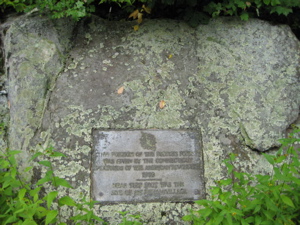
At this point I’m waffling… Do you want to read about the history or the current reality first? The former is very interesting, the latter is not. At all. I guess I’ll go with the current reality. There is a large boulder alongside the road with a bronze plaque embedded into it, noting the importance of the area. I chugged up the Gerard Trail, immediately passing the overgrown foundation of the former Chaugham homestead. The what? Keep reading…
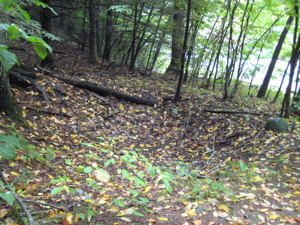
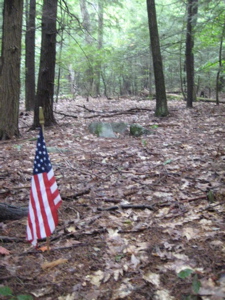
Only a minute or two up the hill the trail leveled out and turned right. Off to the right were a few small rocks pointing up out of the ground. This is the Barkhamsted Lighthouse Cemetery and, quite frankly, would be impossible to find if not for the guidebook telling me to find it and the small US flags scattered about. I mulled around the area (respectfully, of course) and then climbed the trail to the top of the hill.
It is no longer impossible to find at all. There are now (in the 2020’s) several signs that explain the history of the site.
I swung left onto the Robert Ross Trail, then left back down the hill via the Falls Cut-off Trail. This extra walking had a purpose… which would bear itself out a month later when I returned to hike Peoples Forest.
So what’s the big deal? And what does that plaque below say on the boulder? Okay, that one’s easy… it says, “THIS PORTION OF THE PEOPLE’S FOREST WAS GIVEN BY THE CONNECTICUT DAUGHTERS OF THE AMERICAN REVOLUTION 1929 NEAR THIS SPOT WAS THE SITE OF AN INDIAN VILLAGE.” Yeah, so? Does this “Indian Village” have anything to do with a lighthouse in the woods? Yup…
Sometime around 1740, give or take a few years, there lived in the town of Wethersfield a full-blooded Narragansett Indian who went by the unlikely name of James Chaugham (probably pro- nounced “Shawm” or “Shawn”). Born on far-away Block Island, the young man had somehow found his way to Connecti- cut’s second oldest community, adopted the ways of his white neighbors and, through hard work and a pleasing personality, established himself quite well in their regard. If he fancied the English-sounding name “Chaugham,” they said, why not let him use it?
During this same period, there was growing up in a proper Wethersfield family a young woman named Molly Barber. Like some teenagers from time immemorial, Molly provided her family with almost more headstrong personality than they could handle, particularly when it came to men in her life. One day she announced that she was planning to marry a young man whom she knew her father was not too fond of. As she expected, Mr. Barber denied his daughter permission to marry the man of her choice, whereupon Molly threw an old-fashioned temper tantrum. Among other things, she vowed that if she could not wed her current boyfriend, she would henceforth marry the next fellow who asked for her hand, no matter what kind of person he was or — and she knew this would get to her father — what his racial origins might be.
Well, since Molly promptly began broadcasting her availability around town, it didn’t take long for the word to reach the ears of young James Chaugham. One thing led to another, as they say, and before Mr. Barber could do anything about it, Molly and James were united, privately and secretly, in holy matrimony. Then, maybe to avoid her father’s wrath or ostracism by a disapproving community, or perhaps just to find privacy for their new life together, the newlyweds left Wethersfield and headed north into the howling Connecticut wilderness, up around the Massachusetts border.
Some say that they first moved in with some Indians who lived in a little cabin on top of one of the hills above what is now the Barkhamsted Reservoir. But it is more likely that they picked out a homesite on the side of Ragged Mountain, overlooking the West Branch of the Farmington River, about two miles south of Riverton, in an area which today is part of the Peoples State Forest. In this remote country, with not another permanent neighbor within miles, the Chaughams cleared a plot of land and built themselves a log cabin. It was said to be the first home in the town of Barkhamsted. In this place, the Wethersfield emigrants raised eight children, six of whom grew up, married and continued to live nearby their parents’ house, in what became a veritable village of Chaughams.
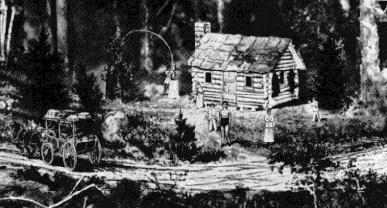
From the beginning, they say, the original log dwelling served as a welcome landmark for the occasional travelers passing along the desolate north-south trail which followed the West Branch of the Farmington. Not only did the house have a number of windows, but it was also not very tightly chinked; so the cooking and heating fires burning day and night, winter and summer, glowed so brightly through the various openings that passers-by began to refer to the lonely cabin as the “Barkhamsted Lighthouse.”
In later years, when the Hartford-Albany turnpike was built along the Farmington River, it passed directly below the Chaugham cabin. With the increased interstate traffic, the fame of the Lighthouse spread, because drivers on the stages making their way south over the toll road would always watch anxiously for the light streaming through the walls of the Chaugham cabin, and when they finally saw it, they would shout to the passengers, “There’s Barkhamsted Lighthouse; only five miles more to New Hartford the end of the route.”
Apparently Molly and James got on well with folks in their region, even though their nearest neighbors were probably down in New Hartford. In fact, they say that James Chaugham would always light a signal fire on the top of Ragged Mountain, up behind his cabin, whenever he learned that the New Hartford settlement was under threat of Indian attack. Then the New Hartford residents would gather in the fortified house they had built to protect themselves from the occasional sorties by hostile Indians out of Satan’s Kingdom, and wait for the Indians to appear or the danger to pass. The people of New Hartford had great affection for the keepers of the Barkhamsted Lighthouse.
All of that quoted text is from a site that no longer exists online.
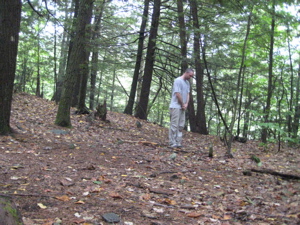
Some of you are saying to yourselves, “Satan’s Kingdom?! Awesome!” Yes, it is awesome.
Although taken from “Legendary Connecticut,” the above story is true. It is told in several books and at the nearby Stone and Barhamstead Historical Museums. (I left out the “After they died there were ghosts and curses” junk.) At any rate, I found that story to be interesting on several levels and am glad I visited.
Speaking of books, I was sent one a couple years after my visit, so I reviewed it.
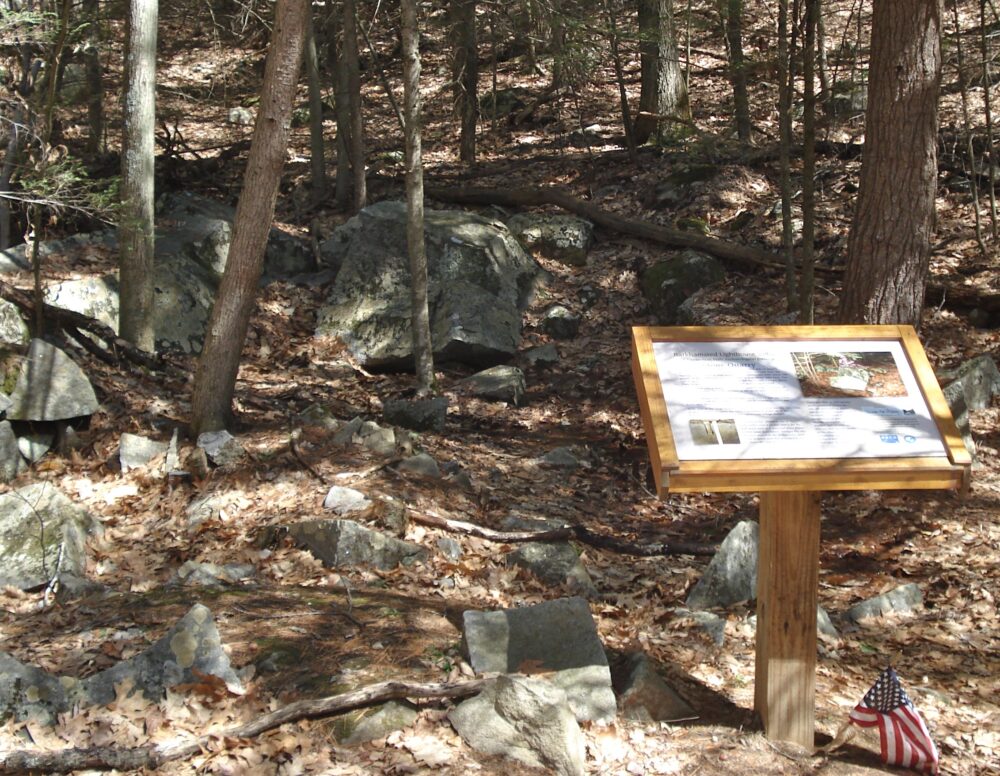

Connecticut Freedom Trail
CTMQ’s Freedom Trail page
CTMQ’s Peoples State Forest Intro