
Not To Judge, But That’s Not Really A Cave Per Se
Judges Cave, New Haven
January 13, 2008
Another old page that I should rewrite someday. At least there are some newer pictures of my family during a later visit.
One thing is for certain here in Connecticut: We call things “caves” that are vastly different from what normal people think of as being caves. As my friend Rob Y said to me just yesterday, “If a rock overhangs a few square feet of ground, it’s called a cave in Connecticut.” Another odd thing about our not-really-caves-caves is that many seem to have a rather incredible story attached to them. White people were always hiding in them back in the day.

While all those caves and dens protected people from capture, it could easily be argued that Judges Cave high atop West Rock in New Haven is the most important and perhaps had the most impact. My friend Andy and I made a visit during our hike of the Regicides Trail, which travels the length of West Rock State Park. The park itself has a rather interesting story, one which I’ll explore in my trail write up a bit more as there is plenty to focus on with the cave now.

“Regicides Trail?” you just said a few seconds ago. Yup… and as all scholars know, a “Regicide” is the murder of a monarch. But there has never been a King (or Queen) in Connecticut. Read on… There is so much online about the rich history of Judges Cave, it would be wasteful for me to just re-do it here.
Here’s a bit by some Yale Forestry student.
I dug further… and found a rather cute yet spartan description written by some kid named Jonathan Lee:
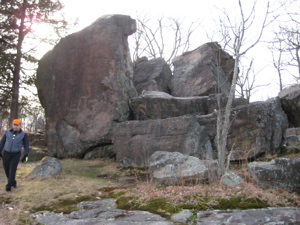
“The thing I remember the most about our field trip to Three Judges Cave is Three Judges Cave. We had to walk about a mile and a half before we were there. As soon as the cave was in sight, we all started running to it. Anyway, some people found a tall structure of rock, which had a little place to sit on (I mean there were no cushions on it but you could sit there without falling off). He thought that this was a lookout. The possibility of that to us seemed very possible! The judges, Goffe, Whalley and Dixwell, could have sat upon the rocks and seen at least a mile. What I also found interesting about the place was the judges’ names, Goffe, Whalley, Dixwell. You may remember those names from three streets in New Haven. Before this nobody knew why they are named, now I do, because of Three Judges Cave!”
It is a really cool story, Jonathan Lee – Back in the 17th century a bunch of judges ordered King Charles I to death, Oliver Cromwell took over afterwards, he died and then Charles II ascended to the throne. He then issued death warrants for all the living judges who put his father to death. Most fled, some were caught.

Two of them ultimately ended up in New Haven, stayed with the Reverend John Davenport (First pastor of Center Church where the Underground Crypt is) and then had to flee to the wilderness to avoid capture from the British. They (Edward Whalley and his son-in-law William Goffe) hid out here, in this cave, to avoid capture. Aided by local anti-royalist Richard Sperry who, with his family, secretly carried food up to the rock to feed the fugitives.

They lived in the rock for a few cold months, being fed by sympathetic local Puritans. Then a catamount (panther) scared them silly so they fled from the big cat. Pure Hollywood stuff. The third judge was some random judge named John Dixwell joined the original two later and hid out up in Massachusetts somewhere.

I don’t mean to gloss over this story, but really… with all the resources online about this already, is one more really necessary? After all, in the end, to paraphrase from young Jonathan Lee above, “The thing I remember the most about my hike to Three Judges Cave is Three Judges Cave.” Good enough for me. So now when driving in New Haven along Whalley Avenue or Goffe Street (and Hamden’s Dixwell Avenue), you can remember their story.

The huge, split, glacial erratic is believed to have originated from the Hanging Hills in Meriden. It has been memorialized in many artist’s paintings, notably Frederic E. Church and George Henry Durrie. (Example above). Durrie’s 1850’s paintings almost always had West Rock in the background and were in such demand, that Currier & Ives reproduced more than a dozen of his paintings and lithographs in the 1860’s. You can check out his work at the New Haven Colony History Museum like I did.)

