We’ve Got This Bridge Covered
Comstock Bridge, East Hampton/Colchester
April 1, 2007
2018: It has been a long, long time since I’ve revisited this page. Or the bridge. So my pictures are too small. But… you’ll survive.
Connecticut has three remaining historic covered bridges and I’ve already been to the two out in the northwest hills during prior travels. They are both drivable and functional. The Comstock Bridge, however, is not. It spans a small river in a tiny little park which is no more than the bridge, a parking lot, the River, and maybe 50 feet of river bank without much of anything to do.

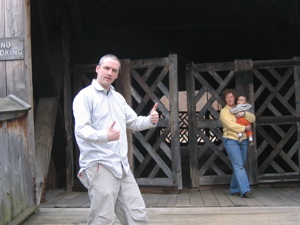
So there I was, staring at an unused bridge in semi-rural Connecticut with my wife, son, and friend, Becky – not sure what our next move was. We had just come from the nearby Chatham Historical Society Museum and were eager for some more CTMQ action. It was rather brisk and gray and, well… there really isn’t a whole heck of a lot to do.
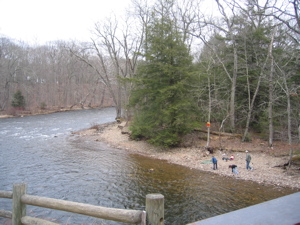
I’d recommend a picnic down on the river bank in warmer weather maybe, and the family who was fishing seemed to be enjoying themselves for the most part. Truth be told, so were we. The Comstock is a rather handsome bridge – Becky even knows a now-married couple that got engaged at this very spot – not quite the Steve/Hoang story on top of Mount Royal overlooking Montreal, but hey, whatever works, right? We walked up to the bridge and soaked in the scenery. Nice.
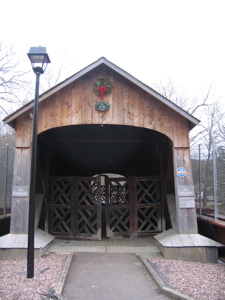
With Hoang and Becky yapping it up, I searched in vain for a historical marker of some sort… Who was Comstock? Why has this bridge survived and most others in Connecticut haven’t? Why was it closed to traffic? And hey, why are covered bridges covered anyway?
So many questions, so few answers. But that’s what the Internet is for, so let’s see what we can find.
The Chatham Historical Society site eloquently says, “Built in 1791 and named by General Comstock, the bridge spans the Salmon River and connects East Hampton to Colchester.” Fair enough… though 20 minutes of Googling “General Comstock” and then variations on the theme came up dry. I’m sorry to say that the mystery of who/which General Comstock the bridge was named after will remain a mystery*.
*See update at bottom.
I would like to point out, however, that I found some fascinating reading on a Civil War veteran named Captain C.B. Comstock (Union) who headed up the Army Balloon Corps at one point. I’ll admit it, I had no idea that there was such a thing during the Civil (or any) war. He was from the Army Corps of Engineers so it would make sense he’s the Comstock in question, but he was only a Captain and from New York… so that doesn’t really add up.
We made our way across the span and noted that the interior was scarred with years of graffiti. Apparently it was much, much worse 15 or so years ago when local groups petitioned the Federal government for some money to save it. In researching that project, I learned more than I ever thought I wanted to know about this particular covered bridge:
This is one of the three remaining covered bridges in Connecticut. Of the three, it is the only one still carrying its own weight with the original timber superstructure. The main span is a 90 ft. long Howe truss built in approximately 1840. It is one of the oldest, if not the oldest, remaining original Howe truss in existence. The truss and floorbeams date from the original time of construction, including the original iron rods. The approach span is a 36 ft. long Queen post pony truss constructed in 1791. The bridge carries pedestrian traffic in a state park setting, and will continue to be a pedestrian bridge after preservation/rehabilitation work. In 1974, major rehabilitation was conducted which included removal of a 12″ negative camber, and strengthening of the bridge. The State notes that the negative camber is returning, the truss is getting out of plumb in opposite directions at each end, and the wood has biological deterioration, although the extent is unknown. The State Historic Preservation Officer (SHPO) has certified that preservation of the bridge is warranted in accordance with SHPO’s Statewide historic preservation plan.
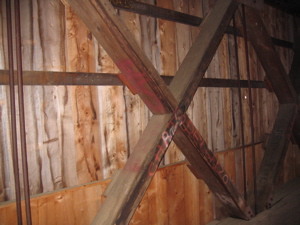
And, as you all know, a negative camber is the death knell of all covered bridges. So they requested $482,800 and received $84,800 according to the Federal Highway Administration. If only they had a modern 21st century appropriations bill to tack it onto, the somewhat barren park would probably have a monorail and glass bottomed boat service. Instead, with their relatively limited funds, the locals did what they could and now that we were across the bridge and gazing back at it, I think they did a lovely job. And since you are now saying, “What exactly did they do?” I’ll let the East Hampton Town website tell you:
In the early 1990’s, there was growing concern over the problem of vandalism at the bridge and the need for extensive renovations. A group of representatives from East Hampton’s civic groups, called C.A.R.E. (Chatham Alliance of Resources) agreed to have lights installed to deter vandalism, make renovations to the bridge, and make exterior improvements to create a park for all to enjoy. For one year this group worked with the Department of Environmental Protection, Department of Transportation, the Connecticut Historical Society and Governor William O’Neill to make all the necessary improvements to the area. On May 19, 1996 the Comstock Bridge was rededicated at a very special ceremony. A new plaque was put on the front of the bridge, shrubs and flowers were planted, a new fence was built and a parking lot was laid, and the bridge was reinforced with wood chosen to match the existing planks.
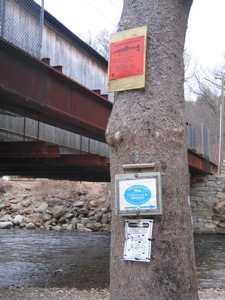
Now across the bridge and approaching private lots, we turned towards the river and went to check out what was there. There were several signs noting the rules and regulations surrounding trout fishing in the river. I also noted that a blue-blaze trail passes through; something called the Salmon River Trail.
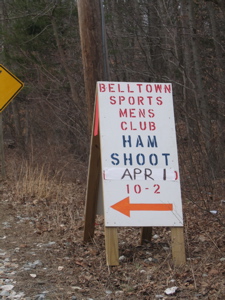
Trout fishing season didn’t open for a few more weeks and I knew when that happens, this bucolic little park would be a madhouse. So with that in mind, we slowly crossed back over the bridge, took one last look, and headed home. On the way, Hoang and I were reminded why we chose not to live in these parts… Hunting defenseless deer sounds boring enough to us, but this? This is just ridiculous:
Oh wait, there’s a rather large looming question still unanswered… Why were covered bridges covered in the first dang place? I turn to the Straight Dope for the answer.
What you’re trying to protect in a covered bridge are the structural members–the trusses. Made of heavy timber, these are the expensive part of the bridge, and if they fall apart due to exposure to the elements, so does the bridge. An unprotected wooden bridge will last maybe ten years. Put a cover over it, however, and it’ll last for centuries. Or at least until some birdbrain adolescent decides to burn it down, the fate of quite a few covered bridges in recent years. But I digress.
Covering a wooden bridge is easy. The trusses already form a boxlike framework. Tack on some rafters and shingles and siding, and there you go. OK, it’s not brain surgery, but somebody had to think it up, and the somebody usually credited is Timothy Palmer, who built the prototypical American covered bridge in Philadelphia between 1800 and 1804. Over time there have been anywhere from 3,000 to 16,000, depending on who’s doing the estimating. Today fewer than 800 remain. Be assured, however, that this dwindling number is the result of progress, heavy trucks, and teenagers, not exposure to the rain.
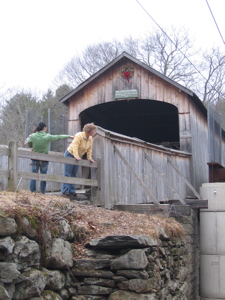
I guess that leaves still one last question… What the heck am I going to write about when I get out to the other covered bridges in Connecticut?
Update! The wonderful book, Connecticut Curiosties by Susan Campbell and Bill Heald solved the mystery of who Comstock was: “Comstock Bridge was named after a formal local postmaster, Franklin G. Comstock.” From the same book, I also learned that, “Town legend says that during prohibition a truck driver crashed on the bridge and tipped over, spilling all the illegal hootch on board. But the locals sprung to action and saved a good portion of the alcohol with buckets.”
Oh, and it was closed to traffic in 1932. Excellent.